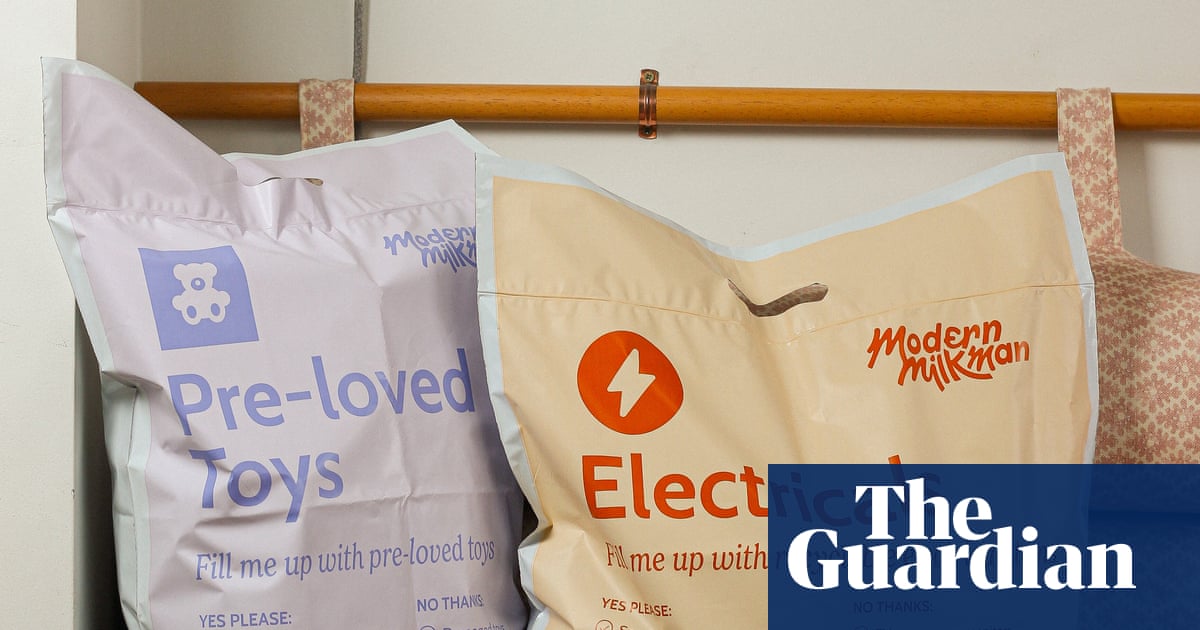
Modern Milkman has secured a £10 million investment to accelerate growth across the UK, expand its US footprint and develop new sustainable doorstep services, taking its total funding to more than £60 million. The Manchester-based business said the funding will support the continued evolution of its doorstep delivery model, as it builds out a broader logistics platform designed to make sustainable grocery shopping easier and more convenient for households. The investment comes from Salica Investments, marking the first direct-to-consumer business backed by Salica's Growth Debt Fund.
One of the earliest large-scale examples of composite materials can be found in the Great Wall of China, where stone, clay bricks, and organic fibers such as reeds and willow branches were blended to create a resilient and lasting structure. These early techniques reveal a timeless intuition: distinct materials, when combined thoughtfully, produce properties unattainable by any single element.
According to research by the World Economic Forum and United Nations Development Programme, the circular economy could unlock $4.5 trillion in new global value by 2030, and investors are racing to capture part of that opportunity. Meet Elizabeth Blankenship-Singh, Director of Innovation at Overlay Capital, an Atlanta-based alternative investment firm whose Waste and Materials Fund is backing both early-stage materials innovators and later-stage recycling operations with established infrastructure.
This week on the podcast, we're sharing an episode of Harvard Business School's Climate Rising podcast. In this conversation, Professor Mike Toffel speaks with James Reinhart, Co-Founder and CEO of ThredUp, one of the world's largest online resale platforms for secondhand clothing. We thought it was the perfect time with the holiday season upon us and the results of ThredUp's 2025 holiday report revealing 40% of holiday budgets will go to secondhand gifts this year.
Joining forces with REEN is a defining step for both companies. Together, we can scale faster, serve customers better, and lead the transformation of how cities and companies manage resources.
As rising emissions targets collide with shrinking material supplies and the growing urgency of climate commitments, the built environment is being forced into a deeper reckoning with how it consumes, circulates, and discards resources. What was once considered waste is now revealing itself as a dormant architectural archive, an urban ecosystem of materials waiting to be reclaimed, revalued, or reimagined.
Communities transform when environmental responsibility shapes their infrastructure strategies. Roads, bridges, and urban systems define daily life, and each decision about materials affects long-term ecological stability. Engineers, contractors, and planners seek methods that preserve natural resources while maintaining structural strength. Governments and local builders benefit when infrastructure projects adopt circular practices. Recycling asphalt saves money by reducing the need for new production and transport. Reclaimed materials also perform comparably to newly manufactured options, offering durability and strength without compromising safety.
The circular economy is a sustainable model of production and consumption that aims to reduce waste and extend the life of resources. Unlike the traditional linear system of "take-make-dispose," it promotes a closed-loop approach where materials are reused, repaired, refurbished, and recycled. This model helps conserve natural resources, lowers environmental impact, and supports long-term economic resilience. A recent report indicates that only 6.9% of the 106 billion tonnes of materials used globally each year are recycled.
Every solar array, battery system, and EV charger installed over the past decade will eventually need to be decommissioned. Yet there's no unifying system to handle that flow of materials-no operating system for the reverse supply chain that the circular economy depends on. While Americans recycle 97% of vehicles, we recycle less than 20% of electronics, leaving valuable critical minerals like lithium, cobalt, and gold to languish in warehouses or end up in landfills.
Ian Falconer kept thinking about the heaps of discarded plastic fishing nets he saw at Newlyn harbour near his home in Cornwall. I thought it's such a waste', he says. There has to be a better solution than it all going into landfill. Falconer, 52, who studied environmental and mining geology at university, came up with a plan: shredding and cleaning the worn out nets, melting the plastic down and converting it into filament to be used in 3D printing. He then built a micro-factory so that the filament could be made into useful stuff.
The B-Clip uses vacuum press forming technology to create a strong, weather-resistant clip from cellulose fibers. Unlike conventional plastic clips, the B-Clip is biodegradable and naturally composts at the end of the growing season. By using renewable agricultural by-products like straw, the project demonstrates how waste materials can be transformed into valuable resources. This approach not only promotes a circular economy but also highlights the potential of sustainable innovation in everyday agricultural tools.
Operating from his unique vantage point between Vancouver's innovation ecosystem and Dubai's capital markets, al Homsi identified critical market gaps that traditional recycling methods could not address. His investment in Aduro Clean Technologies (NASDAQ: ADUR, CSE: ACT) was based on a fundamental insight: existing mechanical recycling technologies were inherently limited by contamination challenges, creating an opportunity for breakthrough chemical processes enhanced by artificial intelligence.
The ARLT Paper Cleaner is a 100% paper-based lint roller that replaces conventional plastic tape cleaners with a fully recyclable, zero-waste alternative. Made from molded pulp and bonded with a water-based adhesive, the product offers a gentle yet effective cleaning surface that is safe for fabrics and delicate surfaces. Its sleek, minimalist design reflects a premium aesthetic while emphasizing eco-friendliness, positioning it as a "Green High-End Brand for Life".
Community RePaint is a UK-wide paint reuse network that collects leftover paint from drop-off points and redistributes it to individuals and groups in the community. They started in 1992 as a research project in Leeds called the Waste Wagon, led by a consortium of waste and recycling organisations and set up in response to concern from the local authority about the high cost of paint disposal and issues around household hazardous waste.
The summer capstone project is a chance for Columbia Climate School's Climate and Society students to put academics into action. After a year spent studying subjects like climate mitigation, adaptation and justice, students partner with an organization-this year's participants included the NYC Department of Health, the National Institute of Urban Affairs, Capgemini, H2Global, the Climate Imaginarium and others-to tackle critical climate challenges in the real world.
A team of South Korean designers transforms discarded eggshells into Re:shell, a biodegradable building material designed as a series of modular, interlocking brick-like elements. Conceived to combat the nation's rising construction waste, the project utilizes the natural properties of eggshells to create a zero-waste composite with applications ranging from small products to large-scale architecture. The blocks safely return to nature at the end of its life cycle, serving as a sustainable solution to a pressing urban problem in South Korea.