#indels

[ follow ]
Medicine
fromNature
20 hours ago

Personalized CRISPR therapies could soon reach thousands - here's how

FDA proposed a 'plausible mechanism pathway' to enhance development of personalized genetic therapies for rare disorders.
fromwww.nature.com
6 days ago

Editorial Expression of Concern: Creation of human tumour cells with defined genetic elements

Concerns were raised regarding a potential duplication of two bands in Fig. 1b. Due to the age of the article, the raw data were not available.
Artificial intelligence
fromFast Company
1 week ago

AI is rewriting the rules of biological experiments, but safety regulations aren't keeping up

AI is autonomously designing and running biological experiments, outpacing current governance systems meant to regulate these capabilities.
Medicine
fromNature
6 days ago

Landmark ancient-genome study shows surprise acceleration of human evolution

Human evolution has accelerated over the past 10,000 years, with significant gene variants identified in ancient populations from western Eurasia.
#gene-editing
Medicine
fromArs Technica
1 week ago

Clinical trial shows gene editing works for -Thalassaemia, too

An improved gene editing system reactivates a fetal hemoglobin gene to treat β-Thalassaemia, building on CRISPR's success with sickle-cell anemia.
Data science
fromMedium
2 weeks ago

In-Silico Perturbation Meets Single-Cell Foundation Models: From Zero-Shot Potential to Fine-Tuned...

In-silico perturbation simulates cellular state changes, but biological trustworthiness remains a challenge despite advancements in single-cell foundation models.
#genomics
Medicine
fromNature
1 week ago

Saturation editing of RNU4-2 reveals distinct dominant and recessive disorders - Nature

De novo variants in RNU4-2 cause ReNU syndrome, a neurodevelopmental disorder characterized by developmental delays and other severe symptoms.
Medicine
fromNature
1 week ago

DNA damage drives antigen diversification in Trypanosoma brucei - Nature

Pathogens like Trypanosoma brucei evade host immunity through antigenic variation, altering surface proteins to escape immune detection.
fromNature
4 weeks ago

Can a mouse be cloned indefinitely? Decades-long experiment has answers

Asexual reproduction is ultimately unsustainable for mice, and potentially other mammals, too. The clones looked normal and lived as long as normal mice. But large mutations - including the loss of an entire chromosome - accumulated in the cloned lineage at an unusually high rate.
OMG science
Science
fromNature
4 weeks ago

Zombieland: Genome transplant brings 'dead' bacteria back to life

Researchers have revived 'dead' bacterial cells by replacing their DNA with a working genome from another species, advancing genome engineering.
Medicine
fromFast Company
2 weeks ago

AI is coming for superbugs

AI can significantly enhance antibiotic discovery, addressing the urgent global health crisis of antibiotic resistance.
fromNature
1 month ago

In vivo site-specific engineering to reprogram T cells - Nature

Using CRISPR-Cas9 and adeno-associated virus (AAV)-mediated homology-directed repair, we targeted CAR integration into the endogenous human TCR alpha locus (TRAC). TRAC-CAR T cells display dynamic CAR expression that delays exhaustion and improves tumour control in xenograft and immunocompetent models. This work has been critical for the development of allogeneic CAR T cell therapy, as it disrupts the TCR after transgene insertion—a necessary step to limit graft-versus-host disease.
Cancer
fromNature
2 weeks ago

DNA damage burden causes selective CUX2 neuron loss in neuroinflammation - Nature

DNA damage can originate from internal sources like metabolic by-products or normal cellular activities, as well as external factors such as cosmic radiation, diet, and pollution.
Medicine
Science
fromNature
1 month ago

Synthetic circuits for cell ratio control - Nature

Synthetic biology enables artificial cell differentiation and division of labor by engineering genetic and epigenetic circuits that mimic natural stem cell asymmetric division processes.
fromNews Center
2 months ago

AI Model May Improve RNA Sequencing Research - News Center

Scientists in the laboratory of Rendong Yang, PhD, associate professor of Urology, have developed a new large language model that can interpret transcriptomic data in cancer cell lines more accurately than conventional approaches, as detailed in a recent study published in Nature Communications. Long-read RNA sequencing technologies have transformed transcriptomics research by detecting complex RNA splicing and gene fusion events that have often been missed by conventional short-read RNA-sequencing methods.
Cancer
fromHarvard Gazette
1 month ago

Tracking mysteries of loss of Y chromosome, cancer - Harvard Gazette

The Y chromosome primarily carries genes that provide instructions for male sex differentiation and fertility. But it also carries some known to suppress tumor growth - a protective ability that is lost if those genes are damaged or destroyed.
Health
Science
fromNature
2 months ago

Construction of complex and diverse DNA sequences using DNA three-way junctions - Nature

DNA writing remains limited by short oligo synthesis and two-way junction assembly methods, hindering affordable, scalable construction of large, complex synthetic DNA.
fromArs Technica
1 month ago

Have we leapt into commercial genetic testing without understanding it?

Martschenko's argument is largely that genetic research and data have almost always been used thus far as a justification to further entrench extant social inequalities. But we know the solutions to many of the injustices in our world-trying to lift people out of poverty, for example-and we certainly don't need more genetic research to implement them. Trejo's point is largely that more information is generally better than less.
Science
Science
fromArs Technica
1 month ago

Large genome model: Open source AI trained on trillions of bases

Evo 2, an AI system trained on trillions of base pairs from all life domains, can identify genes, regulatory sequences, and splice sites in complex genomes including humans.
Medicine
fromThe Atlantic
2 months ago

Their Mutated Genes Were Supposed to Be Harmless

People who carry single-gene mutations for disorders like thalassemia can experience real health effects, including lethargy and fainting, despite being labeled asymptomatic.
fromNature
1 month ago

AI tools can design genomes. Will they upend how life evolves?

Biology is undergoing a transformation. After centuries of studying life as it evolves naturally, researchers are now using a combination of computation and genome engineering to intervene, generating new proteins and even whole bacteria from scratch. The use of artificial-intelligence tools to design biological components, an approach known as generative biology, is set to turbocharge this area of research. Just last year, scientists used AI-assisted design to produce artificial genes that can be expressed in mammalian cells.
Science
Science
fromSilicon Canals
2 months ago

This gene mutation on chromosome 11 is why cilantro tastes like dish soap to millions of people - Silicon Canals

Genetic variation in the OR6A2 receptor causes cilantro to taste like soap to some people by detecting aldehyde compounds present in the herb.
Medicine
fromwww.nature.com
2 months ago

Pre-incision structures reveal principles of DNA nucleotide excision repair

Nucleotide excision repair removes bulky DNA lesions via coordinated recognition, verification, excision, and resynthesis to maintain genome stability and prevent cancer and premature ageing.
fromwww.nature.com
1 month ago

Genetically encoded assembly recorder temporally resolves cellular history

GEMINI leverages a computationally designed protein assembly as an intracellular memory device to record the history of individual cells. GEMINI grows predictably within live cells, capturing cellular events as tree-ring-like fluorescent patterns for imaging-based retrospective readout. Absolute chronological information of activity histories is attainable with hour-level accuracy.

Science
fromMail Online
2 months ago

Scientists use AI to create a virus never seen before

Scientists used AI and gene-assembly tools to create Evo-Φ2147, a novel 11-gene virus designed to kill pathogenic E. coli.
#alphagenome
Science
fromNature
1 month ago

DICER cleavage fidelity is governed by 5-end binding pockets - Nature

DICER is a conserved RNase III enzyme that processes precursor microRNAs and double-stranded RNAs into small regulatory RNAs through precise 5' and 3' end counting mechanisms.
Medicine
fromenglish.elpais.com
1 month ago

The very long road from a cancer cure' in mice to one in humans

Promising mouse cancer cures often fail to become safe, effective human drugs; premature media claims can create false patient expectations and hinder responsible research progress.
Science
fromwww.nature.com
2 months ago

Scalable and multiplexed recorders of gene regulation dynamics across weeks

CytoTape enables multiplexed, genetically encoded, spatiotemporally scalable recording of gene regulation dynamics in single cells for up to three weeks with minute-scale resolution.
Science
fromwww.scientificamerican.com
2 months ago

Google DeepMind unleashes new AI to investigate DNA's dark matter'

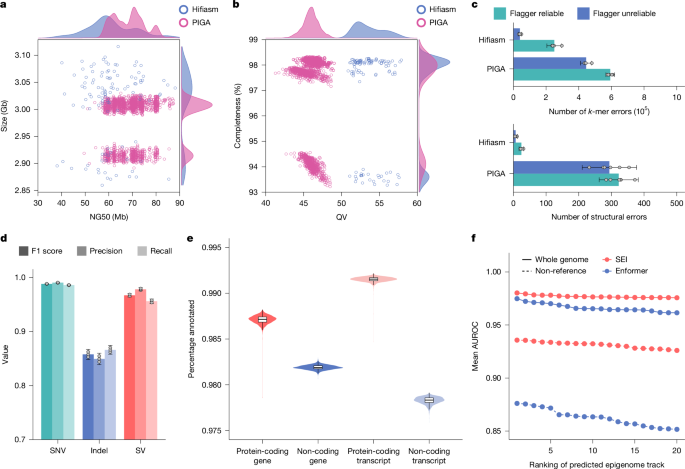
AlphaGenome predicts functional effects of mutations in long noncoding DNA sequences up to one million base pairs, helping interpret genomic variants for disease research.
Science
fromWIRED
3 months ago

He Went to Prison for Gene-Editing Babies. Now He's Planning to Do It Again

He Jiankui created the first gene-edited babies, was jailed and banned, and now seeks to resume controversial genetic research despite widespread germline-editing prohibitions.
Science
fromwww.scientificamerican.com
2 months ago

Cats' cancer genes show striking similarity to humans'

Feline cancers share genetic drivers with human (and dog) cancers, enabling potential targeted treatments, improved diagnostics for cats, and translational insights for human oncology.
[ Load more ]