Arts
fromThe Art Newspaper - International art news and events
1 hour agoClosure of DePaul Art Museum leaves collection in limbo
DePaul University will close its art museum on June 30 despite significant opposition and fundraising efforts.
Glass demands immediacy. Working at temperatures above 2,000°F leaves little room for overthinking, so the process becomes a kind of live dialogue between material, colour and chance. That same immediacy informs what I'm drawn to as a collector: works that carry a decisive gesture, a tactile presence, and the feeling that they could only exist in one form.
Kamrooz Aram is everywhere this year, from Mumbai Art Week to the Whitney Biennial, and critic Aruna D'Souza is grateful. She pens a beautiful meditation on his work, reading his abstract paintings as not simply a denunciation of Western modernism nor a reassertion of Islamic visual motifs, but something else entirely - something gestural, exuberant, riotous, and incomparably his own.
Hong Kong's particular and seductive Metabolist city planning is an ode to consumption as a great totalizer of culture, and to contemporary art as merely a niche commodity form among many others.
Being from the city, I'm used to the billboards of Times Square. I've been around image-making so heavily, my sensibility is being surrounded by images, and then, yeah, growing up with the internet. I love the internet so much.
Bregman claims, 'Today the whole of Europe risks turning into one big Venice, a beautiful open-air museum. A great destination for Chinese and American tourists. A place to admire what was once the centre of the world.' This statement encapsulates the concern that Europe is losing its cultural significance.
Adapted from Rosenkrantz' book of the same name, published in 2022, the film hinges on a single conversation in December 1974, as Hujar recounts, almost pedantically, everything he did the previous day. Drawn from a long-lost tape, the monologue turns errands, meals and irritations into a portrait of an artist's inner life. It trades plot for precision, offering instead a study of friendship, attention and the conditions of making work in 1970s New York.
Candidly, most people visiting the British Museum's Hawaii exhibition probably walk in with a lot of stereotypical preconceptions about the island nation. And will walk out with a totally different understanding of it. Understandably, we probably think of it as not much more than the Pacific island nation that's part of the USA, home to Pearl Harbour and the long-running TV show Hawaii 5.0.
The accompanying catalogue for Hawai' i: a Kingdom Crossing Oceans features more than 150 works, from ancient Hawaiian treasures to important contemporary pieces, telling "a compelling story of movement, allyship and cultural exchange [between the UK and Hawaii]". An inventory of the entire collection of Native Hawaiian works housed at the British Museum, the largest collection outside of Hawaii, is included in the catalogue.
The new New Museum is many things: contemporary, perhaps, but also a science, history, anthropology, and many other museums in one. It echoes the desire of its patron class to own the world and its affiliated courtier class to deliver it to them on a silver platter, or encased in perforated metal, in this case.
The next PST Art will highlight exchange around the Pacific across several centuries, from the arrival of Chinese porcelain in the Spanish missions to the influence of Japanese visual culture on the city's architecture and design, to the ongoing impact of contemporary Korean pop culture.
Although the AGO had planned to jointly purchase Goldin's moving-image work Stendhal Syndrome (2024) with the Vancouver Art Gallery (VAG) and Minneapolis's Walker Art Center, it pulled out in mid 2025 after its modern and contemporary curatorial working committee voted 11-to-9 against it. The move was unexpected, especially as the AGO already had three Goldin works in its collection. (The VAG and Walker Art Center proceeded with the joint acquisition.)
On Franklin Street in Brooklyn's Greenpoint neighborhood, one non-commercial gallery fosters 'a small, stubbornly human space for friction.' Friction—the ubiquitous buzzword that captures the simultaneous delight and discomfort of doing things the slow way—is at the heart of artists Pap Souleye Fall and Char Jeré's current show at Subtitled NYC. It also reflects the overall spirit of this little exhibition space and of a burgeoning movement to reject our culture of optimization in favor of a bumpier, more intimate, less alienating experience.
I've been aware of the Gochman Family Collection for a number of years through my work with artists in the collection, including during the organisation of Jaune Quick-to-See Smith: Memory Map. What drew me to the role was the chance to focus on the parts of curatorial work that excite me most--supporting living artists and helping them realise their visions.
Featuring more than 70 works by a diverse array of artists, including June Clark, Jasper Johns, Faith Ringgold, Robert Rauschenberg, Shepard Fairey, David Hammons, Julie Mehretu, Dread Scott, and Hank Willis Thomas, For Which It Stands... challenges viewers to consider who the American flag truly represents, and whether justice is available to all. On view in Fairfield, Connecticut, from January 23 through July 25, the exhibition opens with Childe Hassam's "Italian Day, May 1918" - lent by Art Bridges - and concludes with a textile sculpture newly commissioned from Maria de Los Angeles. Emma Amos, Eric Fischl, Jane Hammond, and Glenn Ligon are among the many other artists whose work is represented.
Sprouting from the roof of the San Francisco Museum of Modern Art, artist Rose B. Simpson's newly installed bronze sculpture "Behold" has its gaze fixed on the cityscape before it. The Tewa of Khaʼpʼoe Ówîngeh artist, herself a mother, crafted a tender portrait of an interconnected parent and child that "asks us to be human with each other, to change our narrative through wonder, witness and a foundation in the soft warmth of our humanity," she said in a statement.
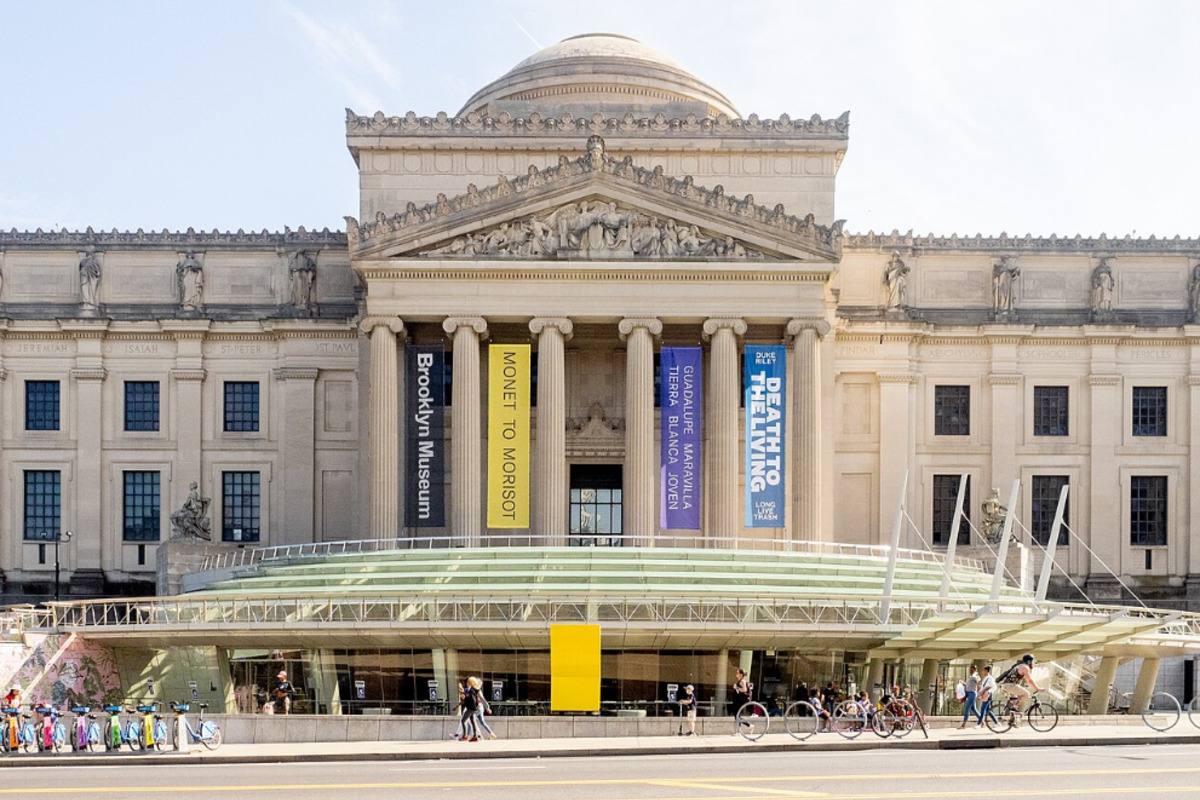
Brooklyn Museum Fills Its Top Contemporary Curator Spot Robert Wiesenberger was named senior curator of contemporary art at the Brooklyn Museum, a post that has been vacant since the departure of Eugenie Tsai in 2023. He comes from the Clark Art Institute in Williamstown, Massachusetts, where he was curator of contemporary projects, and was previously a curatorial fellow at the Harvard Art Museums.
Marah Al-Za'anin, an 18-year-old Palestinian artist, has transformed a tent in Gaza City's Al-Rimal neighborhood into a studio. Al-Za'anin can't have been more than 15 or 16 years old when the genocide began, but she continues to pursue her passion for art and uses her brother's phone as a light source while she paints and draws late into the night. (photo by Saeed Jaras/Middle East Images/AFP via Getty Images)
For some eminently wealthy individuals, amassing a first-class art collection is an ideal way to spend their money. And while some high-profile art collectors end up donating their collections to museums or other cultural institutions, others take a different approach, reselling their art after a certain amount of time. Which brings us to this week, when billionaire David I. Koch's collection of Western art hit the auction block at Christie's, setting a number of records in the process.
Kathleen Goncharov, a longtime curator who served as the United States Commissioner for the 50th Venice Biennale, has died at the age of 73. The news of her passing was announced by a group of friends and her partner, poet and artist Charles Doria. She died of natural causes in her Boca Raton home on New Year's Eve. Goncharov is remembered as a doting friend, a champion of artists, and a gifted and intuitive curator.
Because they've long stopped being about just one depraved pedophile and have come to symbolize the endemic depravity of the world's richest elites. It's no surprise that the art world is implicated. There isn't much difference between a corporation's board of directors and a museum's board of trustees. It's more or less the same money, same power dynamics, and the same creeps crawling through the corridors.
Taking over the museum's transformed school building starting April 16, the cross-borough survey will celebrate MoMA PS1's 50th anniversary with a bevy of site-specific installations, new commissions, and rarely seen work by 53 artists and collectives living and working across New York City. A complete list of participants is included at the end of this article. This year, Greater New York will coincide with the Whitney Biennial for the first time in the show's history.