#virtual-reality
#virtual-reality
[ follow ]
#meta #metaverse #layoffs #reality-labs #augmented-reality #artificial-intelligence #technology #social-media
fromDeadline
1 week agoSEO Edit ( Apr 24, 2026 ) SEO Title (70 character max) Lucy Liu-Voiced 'The Pirate Queen: No Safe Waters' Set For Cannes
Eloise Singer's The Pirate Queen: No Safe Waters is among eight works selected for the Cannes Film Festival's third Immersive Competition, showcasing the evolution of storytelling in immersive formats.
UX design
fromYanko Design - Modern Industrial Design News
2 weeks agoThis Nothing-Inspired XR Headset Displays Your Status So People Know When Not to Interrupt - Yanko Design
Spatial computing is evolving to enhance user immersion while considering real-world interactions, exemplified by the Nothing XR(01) headset's social transparency feature.



fromwww.cbc.ca
4 weeks agoThese Ontario researchers are using virtual reality gaming to help older adults with dementia stay fit | CBC News
"For the ones who are confined in certain spaces or cannot do it independently, this is a great opportunity to transport them to a different reality from the ones that they are currently living in while keeping them active," Munoz told CBC Hamilton from his lab on Laurier's Brantford campus.
Medicine


fromWIRED
1 month agoMeta Is Shutting Down Horizon Worlds on Meta Quest
Meta sent an email blast to Horizon Worlds users today stating that the social VR world will officially end on its Quest VR headsets; starting March 31, Horizon Worlds will no longer be in the Quest store. Some Horizon-specific perks, including Meta Credits, avatars, and some digital clothes and in-world purchases, will also be removed.
Wearables
Video games
fromEngadget
1 month agoGeForce Now adds GOG syncing and 90fps game streaming in VR headsets
NVIDIA GeForce Now enhanced VR streaming to 90 fps for Ultimate members, added GOG account linking, expanded game library with new titles, and introduced in-app subscription labels for improved user experience.


fromThe Verge
2 months agoHow Gorilla Tag is weathering the VR winter
The VR industry has been on edge since Meta's massive job cuts earlier this year: One exec called the layoff announcements "one of VR's darkest weeks." There's talk of a VR winter, and multiple VR studios have conducted significant layoffs of their own. For Gorilla Tag maker Another Axiom, however, it's monkey - or monke, as they'd say - business as usual.
Video games
fromKqed
2 months agoAn Amusing AI Apocalypse in 'Good Luck, Have Fun, Don't Die'
He is there, while customers sip coffee and bite into an omelet, to enlist recruits for the resistance. In the future, he says, people have entirely stopped participating in life. "It all started with morning phone time," he says. In the enjoyably oddball, forebodingly bleak and ridiculously plausible Good Luck, Have Fun, Don't Die, a ragtag group fights a coming AI apocalypse across a handful of nondescript West Hollywood blocks.
Film
fromBusiness Matters
2 months agoThe Evolution of Online Casino Gaming and Its Impact on Digital Business Strategies
The rapid expansion of the online casino industry has significantly impacted digital business strategies. As these platforms continue to grow, they are incorporating cutting-edge technologies to enhance their offerings and improve user engagement. Platforms that are on the rise, like Admiral Casino, exemplify how the industry is leveraging technology to remain competitive. This article explores the technological innovations driving this sector forward and how they are reshaping the way businesses approach digital strategy.
Artificial intelligence
fromFast Company
2 months agoAre we living in a simulation?
How do you know anything is real? Some things you can see directly, like your fingers. Other things, like your chin, you need a mirror or a camera to see. Other things can't be seen, but you believe in them because a parent or a teacher told you, or you read it in a book. As a physicist, I use sensitive scientific instruments and complicated math to try to figure out what's real and what's not.
Philosophy


Video games
fromKotaku
3 months agoMeta Quest 3S Now the Cheapest VR Headset Option After Sudden Price Drop, While PlayStation VR2 Remains at Full Price - Kotaku
Meta Quest 3S provides an affordable, PC-free VR entry with a growing curated library, attractive discounts, and bundled games and subscriptions for new users.





fromPsychology Today
3 months agoYour Life's Work Preserved: Why Collectors Are Going Virtual
The traditional museum experience, pausing in front of an object, and absorbing its history visually or by reading its description, has long shaped how collectors and others relate to cultural treasures. Yet, over the last few decades, digital technology has quietly rewritten many of those rules, changing not only how collections are exhibited but also how they are documented, preserved, and even inherited.
Arts


Tech industry
fromBusiness Insider
3 months agoPalmer Luckey says Meta's VR layoffs aren't a 'disaster' - and fix a problem critics aren't talking about
Meta's Reality Labs layoffs reallocate resources from subsidized first-party VR game development toward core technology and platform stability, not a retreat from VR.
fromThe Drum
3 months agoThe Void co-founder: 'The secret to storytelling in VR? Don't!'
"Storytelling implies one-way communication: I am telling a story and you are listening to it," Hickman told The Drum. "If that's what you want to do maybe don't use an interactive medium to do it. Use a film, use a book, use a blog - tell a story in a medium designed for storytelling. If you're doing it with VR, you have to recognise that no matter what, the person in the virtual world has decision and choice."
Marketing tech
fromInverse
3 months ago30 Years Ago, One Cyberpunk Sequel Was The Weirdest Stephen King Reboot Ever
In 1992, the original Lawnmower Man was way ahead of its time. Loosely based on the Stephen King short story of the same name, the cyberpunk film turned a neurodivergent gardener into a kind of pre- Matrix badass in a virtual world. Starring Jeff Fahey as Jobe and Pierce Brosnan as Dr. Lawrence Angelo, The Lawnmower Man was a haunting, bizarre sci-fi horror movie, which is utterly unlike anything else in cinema history.
Film
fromLos Angeles Times
3 months agoNew VR documentary puts you in the devastation of the L.A. fires - and might help you heal
My eyes zero in on a red door, its frame one of the few surviving remnants of a home. I pull it closer to me, and in moments I see a fraction of the house as it once was - now I'm in a cozy kitchen with blurred but welcoming pictures in the background and a grandfather celebrating a birthday. A voice-over tells me that it was Alexander, a grandfather, who painted the door red.
Film
fromKotaku
4 months agoNew Breath Of The Wild Mod Turns It Into The Ultimate VR Game
BetterVR is a newly released mod for the Wii U-emulated version of Breath of the Wild that lets you play through the entirety of the game through the eyes of Link himself. You'll need a copy of Breath of the Wild on Wii U, a somewhat powerful PC, the Cemu emulator, and, of course, a virtual reality headset like the Meta Quest 3. But if you have all that, you can now virtually explore Breath of the Wild in a whole new way.
Video games
Gadgets
fromFast Company
4 months agoHow this retirement community is using virtual reality to help residents build social connections
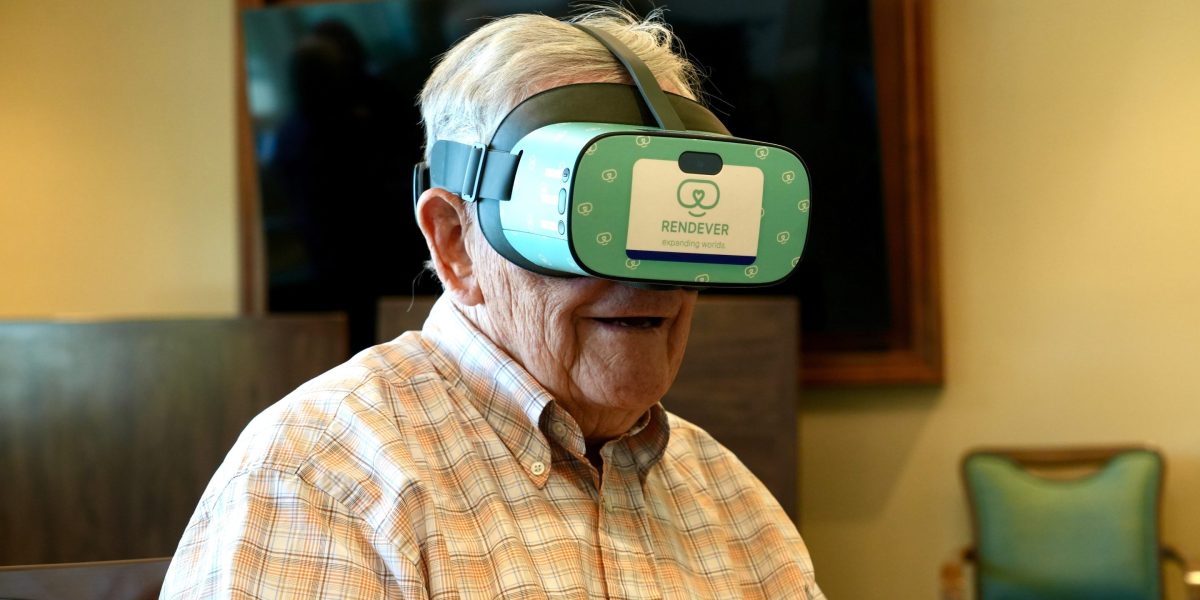
Virtual reality in retirement communities restores memories, enhances cognition, and fosters social connection by bringing elderly residents immersive travel and nostalgia experiences.

Social media marketing
fromThe Drum
4 months ago'VR will arbitrage the internet' - serial entrepreneur Gary Vaynerchuk on start-ups, social, and sleep
Building authentic relationships and creating video content are essential for long-term business success; VR will be a future attention platform but will grow slowly.
fromFuturism
4 months agoRats Successfully Trained to Shoot Demons in "Doom"
With the use of a bootstrap experimental setup consisting of a large polystyrene ball, a curved computer monitor, and a small straw that dispenses sugar water, Tóth managed to teach a rat how to play the classic 1994 video game Doom II. The rat's movements translated into rotations of the ball, which were then translated into movement inside the iconic first-person shooter. The sugar water served as a treat whenever the rat completed a milestone, like walking down a corridor.
Science
fromWIRED
4 months agoA New Las Vegas Attraction Serves Up Alien Foxes, Exoplanets, and VR Carl Sagan
It feels like I've been transported into a scene straight out of a science fiction movie. I'm walking around on a giant centrifuge in space, which I can see the outlines of at the edge of my vision. Beyond it, I see the planet we're orbiting. The pathways I walk on stretch endlessly above and below me, giving me the feeling I'm in an absolutely massive structure.
Gadgets
fromKqed
4 months agoCan Virtual Reality Bring Climate Change Closer to Home? Bay Area Researchers Think So | KQED
Bailenson is the founder of Stanford's Virtual Human Interaction Lab, a research center studying the psychological and behavioral impacts of virtual and augmented reality, the latter of which overlays digital images onto the real world. He's worked on experiments aimed at increasing people's focus on climate change for more than a decade, having found some success. His team discovered that when people put on a VR headset and cut down a tree, feeling the vibration of the chainsaw, they use less paper afterward.
Gadgets
Online learning
fromeLearning Industry
4 months agoFrom Boring To Immersive: How VR Is Transforming Corporate Training ROI
Virtual reality transforms onboarding and training by enabling immersive, interactive experiences that increase engagement, allow safe practice, and reinforce workplace culture and workflow.
fromPsychology Today
4 months agoHow VR Is Changing the Way We Study Habits
A recent study suggests that 65 percent of our daily behaviours are done on "autopilot," meaning that we do them without thinking. These automatic behaviours occur because they are the result of a habitual process. Habitual behaviours are formed through repetition. They can be helpful, like washing our hands, or unhelpful, like biting our nails. Since so many of our day-to-day actions are habitual, understanding how habits form and how we can change them is essential for improving health and productivity.
Psychology
fromKotaku
4 months agoSony Clears Out PlayStation VR2 at Its Lowest Price as Holiday Stock Dump Begins, While Meta Quest Stays Full Price - Kotaku
This brings its usual $400 price down to $299, which, while not the lowest price ever, is still not bad considering all the features the bundle comes packed with. It's open to all shoppers, and you don't have to worry about any delivery charges either. Just be sure to grab it quick. Amazon hasn't specified an end date for this one, but we're not expecting it to stick around for more than a couple of days.
Video games
fromSlate Magazine
4 months agoThe 10 Best Books of 2025
In a chaotic and distressing year, books provided a respite, a chance to commune with works of coherent voice and vision. Some people find it harder to read during days overflowing with one-minute distractions and incessant notifications, but when I took the time, I was rewarded with a slightly bigger foothold in a world of decency, humanity, patience, and compassion. Here are 10 good reasons to give that a try.
Books
fromMedium
5 months agoDawn of the undead peripheral
The toxicity of his products is exceeded only by his gormless demeanour (let he who is without sin, cast the first stone). Yet, even those who consider him an enemy of humanity must admit that Zuckerberg possesses a talented grasp on the fundamentals of technology trends. Despite the clinical efficiency of his businesses in spreading misery, or perhaps proof of how well the product has been engineered underneath the hood - offerings like Facebook, Instagram and Whatsapp, it is fair to acknowledge, are tightly-built products.
Tech industry

fromIPWatchdog.com | Patents & Intellectual Property Law
5 months agoUnderstanding IP Matters: AI Won't Replace Human Creativity
Artificial intelligence (AI), viewed from an optimist's perspective, is an accelerant for humans; a tool to handle tedious tasks that allow users to spend more time and energy on what really matters. On the current episode of Understanding IP Matters (UIPM), Eric Bear, a classically-trained actor, singer and dancer, and now a kinesthetic artist specializing in primate motion capture, discusses the interplay of creativity and technology. Bear is a successful entrepreneur, industry expert and inventor responsible for more than 100 patents.
Artificial intelligence
[ Load more ]