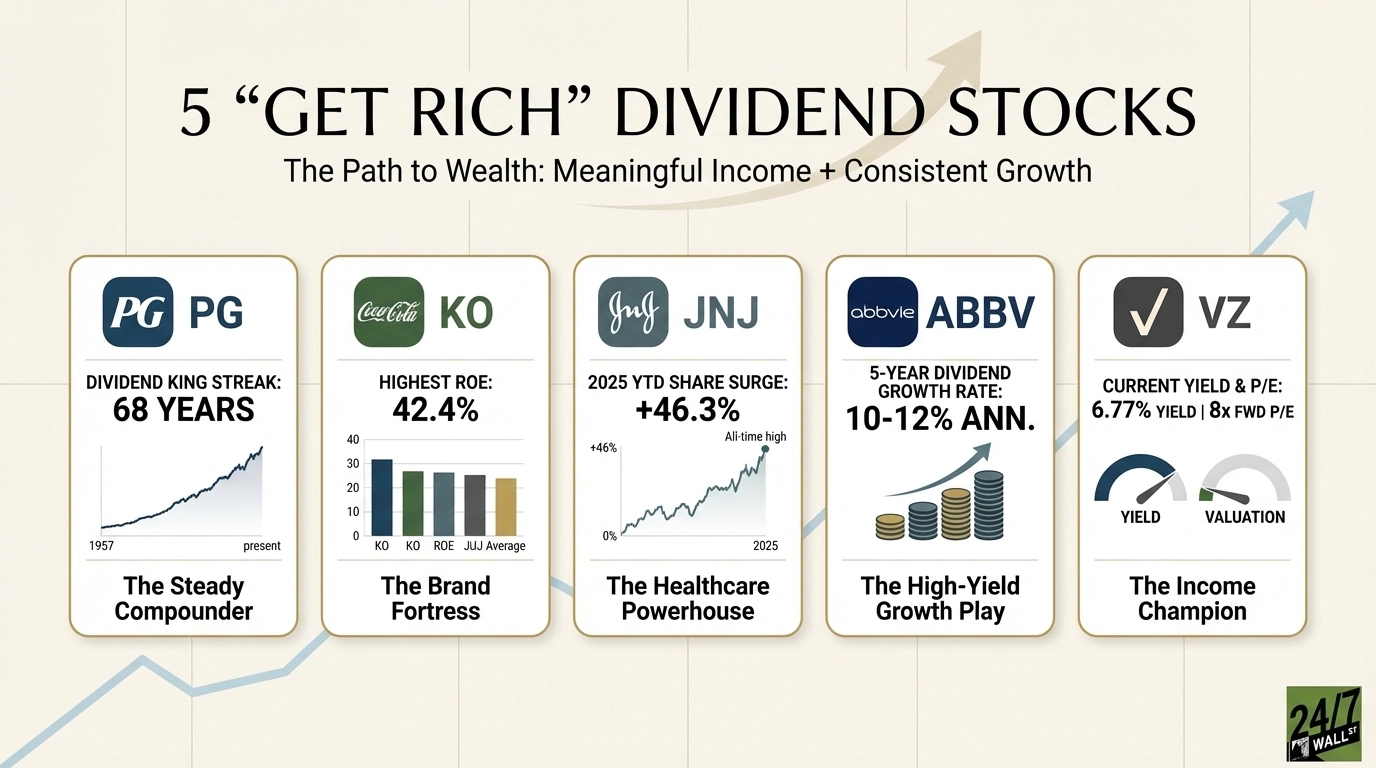
Building wealth through dividends requires more than chasing high yields. The path to "getting rich" combines meaningful current income with consistent dividend growth, backed by sustainable business fundamentals. These five stocks deliver that combination, each offering distinct advantages for compounding wealth over time. #5: Procter & Gamble (PG): The Steady Compounder Procter & Gamble earns its place as a 68-year Dividend King, having increased its payout annually since 1957. The consumer staples giant recently raised its quarterly dividend to $1.06, maintaining a 2.93% yield
There are a host of dividend stocks that people don't spend enough time talking about, and they don't get the same kind of hype as the bigger names. The thing is, these firms operate in steady industries and continue to raise their payouts, all while delivering market-beating performance. The best of each of these three under-the-radar names is that they don't rely on hype.
Waste Management paid $1.21 billion in dividends against $2.16 billion in free cash flow during 2024, producing a 56.0% FCF payout ratio. That leaves nearly $950 million in retained cash after dividends. The trailing earnings payout ratio sits at 50.9% ($3.225 divided by $6.34 EPS). Over eight years, the FCF payout ratio averaged 49.4%, ranging from 39.8% in 2021 to 62.3% in 2023. Operating cash flow surged 69% from $3.18 billion in 2017 to $5.39 billion in 2024.
When it comes to picking dividend stocks, you not only want a firm that can support a generous payout, but one that can grow it at a fairly predictable rate over extended periods of time. Indeed, when thinking about dividend stocks with a long-term horizon in mind, I think it makes more sense to focus on the growth profile and the shareholder-return policy than just how large the upfront yield is.
Dividend investing is tricky business. On the one hand, investors looking for yield are enticed to consider the highest-yielding names in a given group. That said, as a stock's overall dividend yield rises, its risk profile inherently rises. Any time an investor sees a company with a double-digit yield or something outside of what most would consider to be a "normal" range, it's probably a company that's at risk of a dividend cut or further downside. That's what the market is saying at least.